
ON THIS PAGE
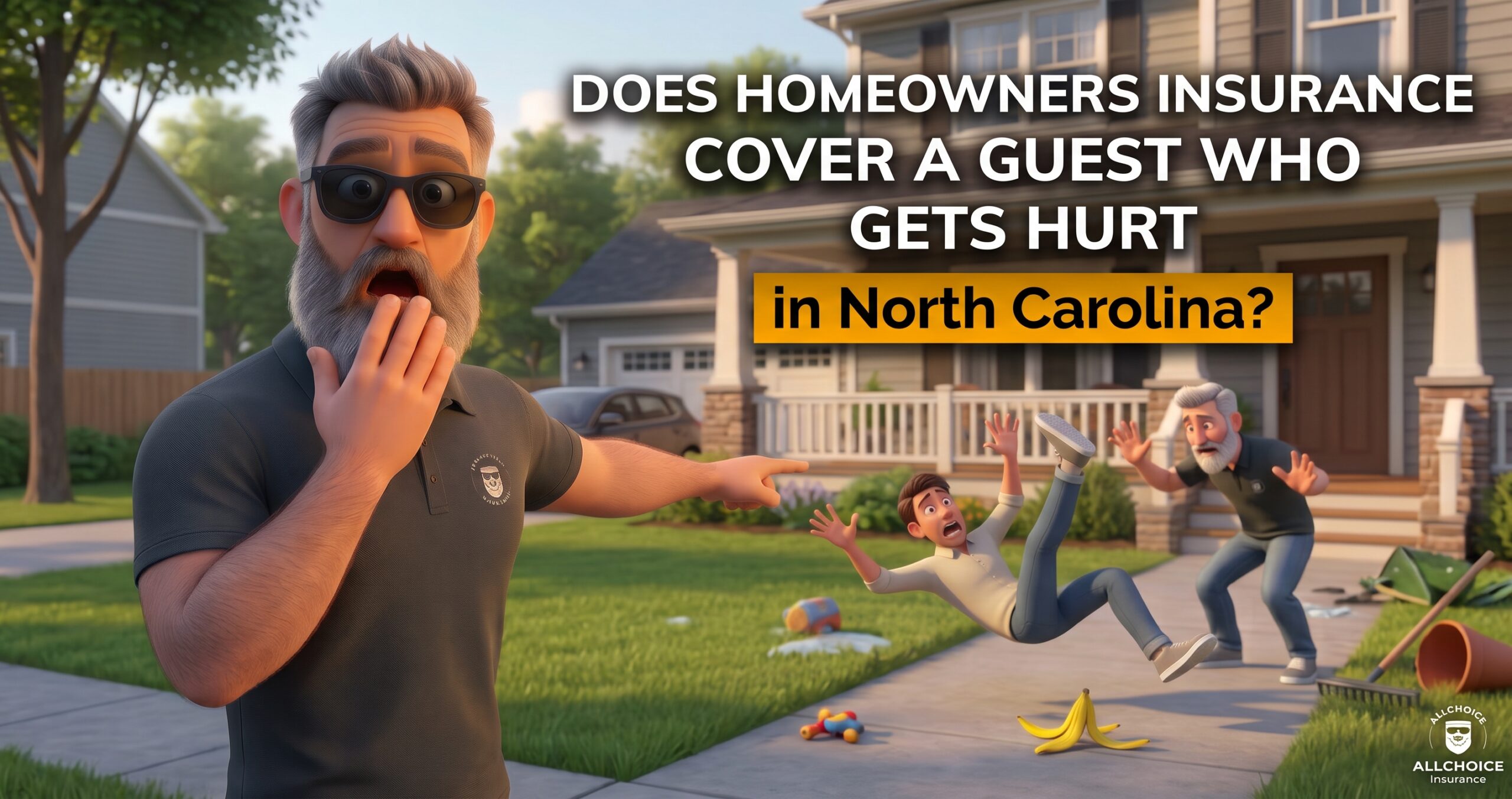
Quick answer: Usually, yes. Homeowners insurance has two parts for a guest who gets hurt at your home: medical payments to others, which pays smaller medical bills without anyone proving fault, and personal liability, which pays if you’re legally responsible and can provide your defense. Dogs, pools, trampolines and home businesses depend on your policy.
What we see at ALLCHOICE
The pattern: Every year as the holidays near, clients getting ready to host a full house call us. The questions sound alike: what if someone slips on the porch steps, trips over a toy, or gets nipped by the family dog? And the real worry underneath: “Will my policy pay, or will I?”
What our ALLCHOICE Risk Advisors tell them: Most homeowners policies have two coverages built for this, and they work differently. One handles the doctor bill quickly. The other protects you if the guest blames you. Check both limits before the guests arrive.
Hosting this season? Your Risk Advisor can check your liability and medical payments limits in a few minutes, or we can compare home coverage from 20+ carriers.
Which part of homeowners insurance pays when a guest gets hurt?
Two coverages in Section II of a standard homeowners policy. The NC Department of Insurance calls them Coverage E, Personal Liability, and Coverage F, Medical Payments to Others.
Medical payments asks, “Was someone accidentally hurt here?” Liability asks, “Are you legally responsible?” The same fall can involve both.
| Medical payments to others | Personal liability | |
|---|---|---|
| Must someone prove fault? | Generally no | Legal responsibility is generally required |
| What it pays | Eligible medical bills | Covered damages, plus a legal defense |
| NC homeowners form minimum | $1,000 | $100,000 |
| Deductible | Does not apply | Does not apply |
When does medical payments to others pay a guest’s bills?
When a guest is accidentally injured on your property, whether or not you did anything wrong. It is meant for smaller bills, like urgent care or stitches.
- Limit: NC homeowners forms carry a minimum of $1,000, according to the NCDOI consumer guide.
- Who it doesn’t pay for: you and anyone who lives in your household.
- What it usually excludes: business activities. NCDOI notes it may also pay for some injuries you cause away from home, in limited circumstances.
When does personal liability step in?
When a guest claims you are legally responsible for the injury. Liability pays covered damages, up to your limit. It also provides a legal defense against a covered claim, and under many standard policies defense costs are paid in addition to the limit. Your policy wording controls.
NC homeowners forms carry a liability minimum of $100,000, per the NCDOI consumer guide. The Insurance Information Institute reports the national average dog-related injury claim reached $65,450 in 2025. As an illustration, one average claim would use about two-thirds of that minimum.
Liability does not cover everything. NCDOI points out it won’t protect you for an intentional act, and your policy lists others.
Do dog bites, trampolines and pools change the answer?
They can. The answer lives in your policy wording and what you told the carrier when you bought it.
- Dogs: many policies cover a bite under liability. Some limit or exclude certain breeds or a dog with a bite history. The NCDOI guide warns that some dogs can lead to a cancellation or nonrenewal.
- Trampolines: some policies exclude them; others expect safety netting.
- Pools and hot tubs: usually covered when disclosed, but carriers often expect a fence and a locked gate. NCDOI says pools “should be fenced and locked.”
Added a dog, trampoline or pool lately? Tell your Risk Advisor now, not during a claim.
When does a guest injury call for an umbrella policy?
When a serious injury could cost more than your liability limit. Anything above it can come back to you personally.
A personal umbrella policy adds a layer of liability coverage above your home and auto policies, under its own terms and exclusions. Carriers usually require certain underlying limits first, so the umbrella and the homeowners policy need to be set up together. If you host often, have a pool or a dog, or have assets to protect, an umbrella is worth a look. Learn more about umbrella insurance or request an umbrella quote.
What this means in North Carolina
NC law asks property owners to use reasonable care to keep their home safe for lawful visitors. That standard comes from the NC Supreme Court’s 1998 decision in Nelson v. Freeland, as summarized in the NC pattern jury instructions.
North Carolina is also, per the UNC School of Government, one of a handful of places that still follow contributory negligence in North Carolina. A guest whose own carelessness helped cause the injury may be barred from recovering. How that applies to a specific injury is a question for an attorney. For you: liability coverage usually provides a defense while it gets sorted out, and medical payments generally doesn’t require a finding of negligence.
Dogs carry one more rule. Under N.C. Gen. Stat. 67-4.4, the owner of a dog that meets the statute’s definition of dangerous can be strictly liable for injuries it causes. Whether your policy covers that liability is a separate question.
Risks differ across our markets:
- Triad: icy steps and uneven walks after winter storms.
- Asheville and Hendersonville: steep driveways, decks and rental guests.
- Wilmington: docks, pools and boat outings.
At a glance: guest injuries that are usually covered, not covered, or depend
| Situation | Usually | Which coverage |
|---|---|---|
| A guest slips on your front steps and visits urgent care | Covered | Medical payments, up to its limit |
| A guest claims you were careless and sues | Covered | Personal liability, which can include a legal defense, subject to policy terms |
| Your dog bites a visiting neighbor | Depends | Liability, unless your policy limits or excludes the dog |
| A child is hurt on your trampoline or in your pool | Depends | Liability and medical payments, subject to exclusions and safety requirements |
| You or someone who lives with you gets hurt | Generally not covered | Medical payments generally excludes insureds; use health insurance |
| A paying customer is hurt during a home business visit | Usually excluded | Homeowners policies commonly exclude business activities; ask about an endorsement or business coverage |
| A claim larger than your liability limit | Not covered above the limit | A personal umbrella may pick up the excess, under its own terms |
What should you do if a guest gets hurt at your house?
Take care of the guest first, then protect your claim.
- Get medical help first. Call 911 for a serious injury.
- Document what happened. Take photos and note the date.
- Call your Risk Advisor or carrier promptly.
- Don’t promise payment or admit fault. Let the insurance company investigate.
- Send any demand letter or lawsuit to your insurer right away.
People also ask
No. According to the NC Department of Insurance, the deductible does not apply to the liability or medical payments coverages on a homeowners policy. It applies to damage to your own property.
It depends on where they live. Relatives who live with you generally count as insureds, so medical payments doesn’t pay for them and liability has exclusions for injuries to insureds. Their own health insurance usually applies. A relative visiting from another home is generally treated like any other guest, subject to your policy.
Usually, yes. Renters policies in NC typically include personal liability and medical payments to others, much like a homeowners policy. The landlord’s policy covers the building, not your liability as a tenant.
Often, yes. Personal liability usually follows you, so a bite at a park or a friend’s house can be covered, subject to your policy’s animal rules. Medical payments may also pay in limited circumstances away from home.
Final Verdict
A guest who gets hurt at your NC home is usually covered, through medical payments for the small bills and personal liability for the bigger ones. The gaps are in the details: household members, business use, dogs, pools and limits lower than a serious injury costs. Ten minutes with your declarations page before the holidays shows where you stand.
See home and liability options from 20+ carriers
Already a client? Visit the Member Center or call 844.540.0463 to review your liability limits with your Risk Advisor.
Related: Home insurance in North Carolina · What Is the North Carolina Beach Plan? · Does Homeowners Insurance Cover a Turkey Fryer Fire in NC?
Sources
- A Consumer’s Guide to Homeowner’s Insurance, NC Department of Insurance
- Basic Homeowners Insurance, NC Department of Insurance
- Renters Insurance, NC Department of Insurance
- Triple-I Highlights Growing Insurance Needs for Pet Owners (May 13, 2026), Insurance Information Institute
- N.C. Gen. Stat. 67-4.4, North Carolina General Assembly
- N.C.P.I.-Civil 805.55, Duty of Owner to Lawful Visitor, UNC School of Government
- Fault Lines: Understanding Negligence Doctrines, UNC School of Government
Coverage depends on your policy, carrier and situation. This article is general information, not a coverage decision — talk to your Risk Advisor about your policy.