
ON THIS PAGE
Quick answer: The North Carolina Beach Plan, now the Coastal Property Insurance Pool, is the state-created insurer of last resort for homes and businesses in 18 coastal counties. It sells full homeowners policies and separate wind and hail policies when the regular market won’t cover a property, or won’t cover wind.
What we see at ALLCHOICE
Some of the most confused calls we get from the coast start the same way: “Why do I have two insurance bills for one house?” A homeowner in one of the coastal counties opens their paperwork and finds a regular homeowners policy with wind and hail excluded, plus a separate wind and hail policy from the Beach Plan.
Often nobody explained why at closing. We walk them through it: the first policy covers things like fire, theft and liability, and the second fills the wind gap. Then we check whether the regular market will now take the wind coverage back.
Have a coastal home with wind excluded, or a Beach Plan policy you’ve never compared? We compare available options from multiple carriers and can check whether the regular market will write your wind coverage.
Who runs the Beach Plan, and why does it have so many names?
The Beach Plan is run by the North Carolina Insurance Underwriting Association (NCIUA), an association of insurance companies created by state law. It now does business as the Coastal Property Insurance Pool, which its own site describes as “formerly known as the Beach Plan.”
The General Assembly created it in 1969 so coastal property owners can buy essential property insurance. You’ll still hear all three names, and they mean the same thing.
The pool calls itself the “market of last resort”: it’s there for properties the regular market won’t insure, and it recommends trying the standard market first.
Who can get Beach Plan coverage in North Carolina?
Property owners in the state’s beach and coastal areas can apply, as long as they have an insurable interest in the property. Under N.C. Gen. Stat. 58-45-5, those areas are defined like this:
- Beach area: land south and east of the inland waterway from the South Carolina line to Beaufort Inlet, then south and east of the Core, Pamlico, Roanoke and Currituck sounds to Virginia. In plain terms, the barrier islands and the Outer Banks.
- Coastal area: the rest of these 18 counties: Beaufort, Brunswick, Camden, Carteret, Chowan, Craven, Currituck, Dare, Hyde, Jones, New Hanover, Onslow, Pamlico, Pasquotank, Pender, Perquimans, Tyrrell and Washington.
Wilmington, for example, is in New Hanover County, so it’s in the coastal area.
Does the Beach Plan sell full homeowners policies or wind-only coverage?
Both. The Coastal Property Insurance Pool offers full homeowners policies and separate windstorm and hail policies in both the beach and coastal areas.
Its products:
- Homeowner policies (beach and coastal areas)
- Homeowner windstorm and hail, and dwelling windstorm and hail (beach and coastal areas)
- Commercial windstorm and hail (beach and coastal areas)
- Dwelling fire, commercial fire and crime (beach area only)
A “dwelling” policy is the kind usually written for a home you don’t live in, such as a rental or investment property. For homes, the pool’s maximum building coverage is $1,000,000, with personal property limited to 40% of the building amount. If the building coverage you need is higher, you have to buy excess coverage for the rest before the pool will issue your policy.
How does a Beach Plan wind policy work with my regular home policy?
It fills a gap. Near the coast, your regular home policy may exclude windstorm and hail, depending on where you live and your insurer’s rules. A Beach Plan wind and hail policy then covers that one peril.
To qualify, you need an active primary policy from a carrier licensed in North Carolina that excludes wind. The wind policy has to match that primary policy as closely as possible: same dates, same limits, same policy form. That’s why we check both policies side by side.
Two things surprise people:
- Separate deductible. The wind policy has its own deductible, which is often a percentage of your dwelling coverage. Our post on whether you have a hurricane deductible on your NC home insurance shows how to work out that number in dollars.
- Who handles the claim. For named-storm losses, North Carolina law has your primary insurer, not the pool, investigate and adjust the claim under a separate NCIUA wind policy. For other wind or hail losses, call your agent first so the claim goes to the right company.
How much does the Beach Plan cost, and what’s changed recently?
There is no single price. Your premium depends on where the property is, how much coverage you need, the policy type, your deductible and any mitigation credits. The pool is built to cost more than comparable coverage at regular Rate Bureau rates.
If your regular policy excludes wind, you pay two premiums: the regular policy for things like fire, theft and liability, and the pool’s wind and hail policy. Compare the combined annual premium, limits and deductibles, not one bill alone.
State law sets the formula. Under N.C. Gen. Stat. 58-45-45, the pool’s rates are the NC Rate Bureau manual rates plus 5% for wind and hail coverage, or plus 15% for homeowners coverage. Those percentages are added to the manual rate, so they are not a fixed price. The law says the surcharge is there to keep the pool the market of last resort.
Because the pool’s rates start from Rate Bureau manual rates, approved statewide changes can affect pool premiums. How and when a change reaches your policy depends on your coverage and policy type, because wind and hail policy rates are filed separately with the Commissioner. For context, NCDOI’s 2025 homeowners settlement raised average base rates 7.5% on June 1, 2025, and 7.5% more on June 1, 2026. It also bars the Rate Bureau from seeking another increase before June 1, 2027. If your renewal jumped, our post on what to do when your NC home insurance renewal goes up walks through your options.
Stronger roofs help too. NCDOI says an IBHS FORTIFIED roof earns Beach Plan policyholders insurance credits that reduce premiums. Its 2025 Strengthen Your Coastal Roof round offered eligible policyholders grants of up to $6,000 in coastal areas, and up to $10,000 on the Outer Banks and barrier islands through a separate program. Funding is first-come, first-served, so check what’s open now.
What this means in North Carolina
On the coast, the Beach Plan is a normal part of the market, not a sign something went wrong. Many coastal homeowners carry it alongside a regular policy.
In the Piedmont and the mountains, it doesn’t apply. Homes in Greensboro, Winston-Salem, Asheville or Hendersonville can’t get Beach Plan coverage, and wind is usually part of a standard home policy there. Inland, the separate FAIR Plan is the state’s backstop instead.
Beach Plan vs. FAIR Plan at a glance
| Feature | Beach Plan (Coastal Property Insurance Pool) | FAIR Plan |
|---|---|---|
| Where it applies | Beach area and coastal area (18 counties) | Elsewhere in North Carolina, outside the beach area |
| Main policies | Homeowners, wind and hail, dwelling fire and commercial fire (beach area only) | Mainly dwelling fire and commercial fire |
| Residential building limit | $1,000,000 | $1,000,000 |
Because the pool costs more than Rate Bureau rates by design, it’s worth asking at each renewal whether the regular market will take your wind coverage back. As an independent agency, we can shop the same home across multiple carriers. For how wind coverage fits with the rest of your policy, see our North Carolina wind and hail insurance page.
What it means for you: a Beach Plan checklist
- Look at your declarations pages. Is wind and hail excluded from your home policy, and is there a separate wind policy?
- Write down your wind deductible in dollars, not just as a percentage.
- If the building coverage you need is above the pool’s $1,000,000 limit, make sure excess coverage is in place.
- Ask about wind mitigation credits if you have, or plan to install, a FORTIFIED roof.
- At renewal, ask your Risk Advisor whether the regular market will now write your wind coverage.
People also ask
No. They are run by related associations, but the FAIR Plan covers property elsewhere in North Carolina, outside the beach area, mainly with dwelling fire and commercial fire policies. The Beach Plan, now the Coastal Property Insurance Pool, covers the beach and coastal areas and adds homeowners and wind and hail policies.
There is no single price. Your premium depends on the property’s location, the coverage you need, the policy type, your deductible and any mitigation credits. By law, pool rates are the Rate Bureau manual rates plus a 5% surcharge for wind and hail or 15% for homeowners coverage, so it is designed to cost more than the regular market. If you also carry a regular policy, add both premiums together.
No. None of the pool’s policy types is flood insurance. Flood coverage comes from a separate flood policy, which you would buy in addition to your home and wind coverage.
Often, yes. The pool writes dwelling policies, the kind used for rentals, and whether a specific property qualifies depends on its location and the pool’s rules.
Yes, if a regular carrier will write the coverage. The pool is meant to be a market of last resort, so it’s worth having your wind coverage re-shopped at renewal. Line up the new coverage before you cancel the old policy, so there’s no gap.
Final verdict
The Beach Plan is the coast’s safety net: for eligible properties in those 18 counties, it offers coverage when the regular market won’t, subject to the pool’s eligibility rules and limits. It is built to cost more than the standard market, so it should be your fallback, not your starting point. If you carry a Beach Plan policy, have it re-checked at every renewal.
Sources
- Coverage and services, NCJUA/NCIUA (Coastal Property Insurance Pool)
- Increased maximum limits notice (effective Nov 2, 2023), NCIUA
- Who We Are, NCJUA/NCIUA
- Named storm claims procedure (G.S. 58-45-35(e)), NCIUA
- Windstorm and Hail, NC Department of Insurance
- N.C. Gen. Stat. 58-45-5 (definitions), North Carolina General Assembly
- N.C. Gen. Stat. 58-45-45 (rates), North Carolina General Assembly
- Homeowners rate settlement, NCDOI press release, Jan 17, 2025
- Strengthen Your Coastal Roof grant, NCDOI, Jul 30, 2025
Coverage depends on your policy, carrier and situation. This article is general information, not a coverage decision — talk to your Risk Advisor about your policy.
<!– SEO
Title tag: What Is the NC Beach Plan? Coastal Pool Explained
Meta description: The NC Beach Plan, now the Coastal Property Insurance Pool, insures homes in 18 coastal counties. Who it's for, how wind-only policies work, and rates.
Slug: nc-beach-plan
Category: Home Insurance Education
Excerpt (= Quick Answer): The North Carolina Beach Plan, now the Coastal Property Insurance Pool, is the state-created insurer of last resort for homes and businesses in 18 coastal counties. It sells full homeowners policies and separate wind and hail policies when the regular market won't cover a property, or won't cover wind.
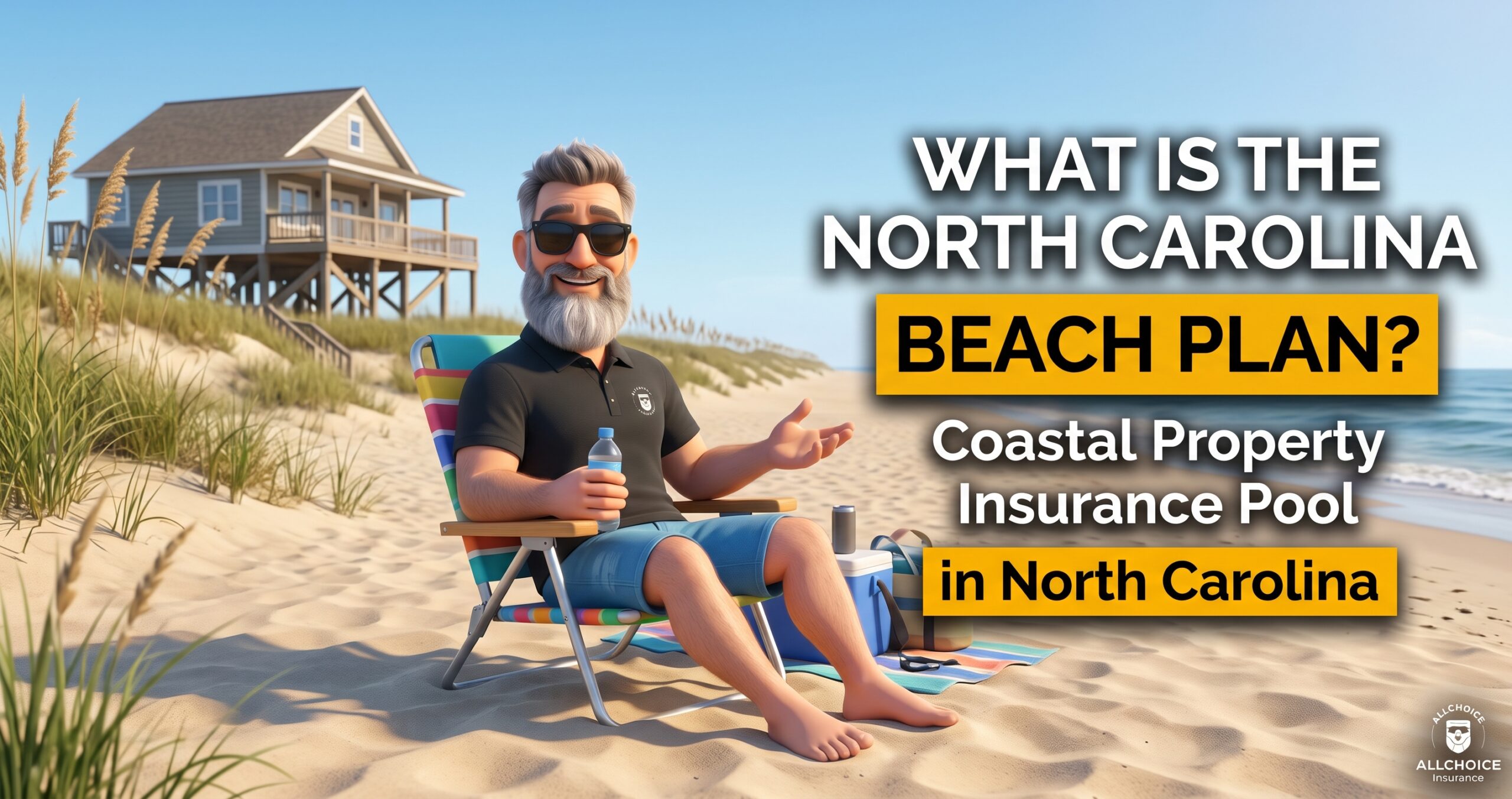
Featured image brief: 1200×628 WebP. Real photo preferred: a raised beach house behind dune grass on the southeastern NC coast (Wilmington area), clear sky; no stock clichés, no storm imagery. Alt text: "Raised beach house behind dune grass on the North Carolina coast"
Internal links: /wind-and-hail-insurance/ (service page), /hurricane-deductible-nc-home-insurance/ (previous post, same category), /nc-home-insurance-renewal-increase/, /what-is-coastal-insurance/, /flood-insurance/.
Link-back candidates: /wind-and-hail-insurance/ (its FAQ "What is the NC Beach Plan?" should link here), /what-is-coastal-insurance/ ("Beach/Wind Plans" mention), /hurricane-deductible-nc-home-insurance/, /how-much-is-coastal-insurance-for-homeowners/, /do-i-need-wind-and-hail-insurance/.
JSON-LD: Article + FAQPage, organization @id https://allchoiceinsurance.com/#organization. FAQPage questions/answers must match the five visible People Also Ask H3s and their
answers WORD FOR WORD. No AggregateRating or Review schema. Remove all [UNASSIGNED]/REVIEW FLAG text before publishing.
–>